
New Publication: Quasi-isotropy of nanocrystalline silicon film: An inelastic light scattering study
The LEIT Project is proud to announce the release of its latest publication, "Quasi-isotropy of Nanocrystalline Silicon Film: An Inelastic Light Scattering Study," featured in Applied Physics Letters.
Authored by Manjunath Balagopalan, Yani Chen, Omid R. Ranjbar Naeini, Gloria Conte, Jouni Ahopelto, Oili M.E. Ylivaara, Tapani Makkonen, and Clivia M. Sotomayor Torres, and supported by the LEIT Project (ERC Advanced Grant) and MUSICIAN CHISTERA, the study investigates the quasi-isotropy of nanocrystalline silicon films.
The publication further demonstrates how reduced structural anisotropy contributes to more uniform physical responses, an important factor when considering robust, low-loss information propagation in functional materials.
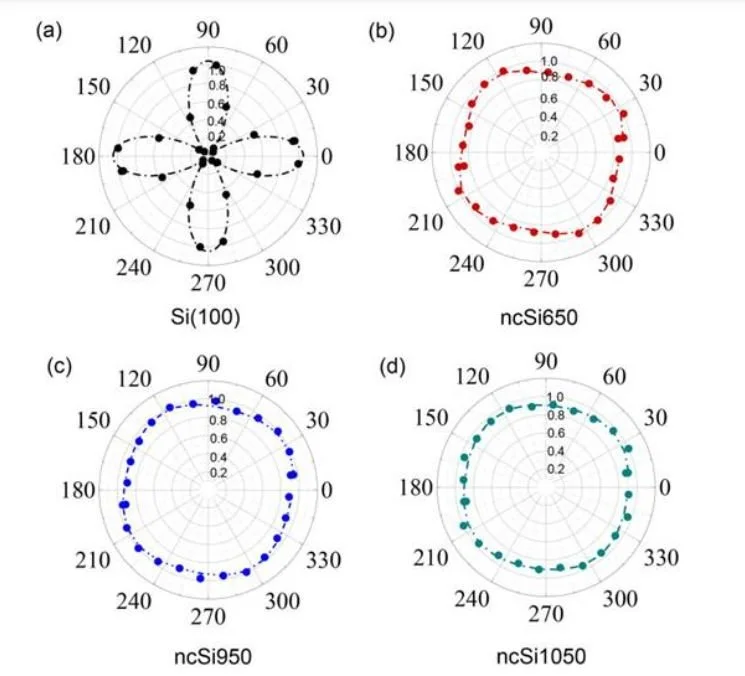
Abstract:
Nanocrystalline silicon thin membranes exhibit high potential in micro-electro-mechanical systems and in optoelectronic and optomechanical applications due to the distinct microstructure, which enables enhanced nonlinear dynamics, broader operational bandwidth, and tunable mechanical and thermal properties compared to single-crystalline silicon. This work presents a comprehensive investigation of the structural characteristics of nanocrystalline silicon using angle-resolved polarized Raman spectroscopy. Our analysis reveals a striking transition from the strong anisotropy of crystalline Si(100) to a quasi-isotropic behavior in nanocrystalline silicon. Inelastic light scattering provides an efficient nondestructive method to characterize the crystallographic texture of nanocrystalline semiconductor films, offering valuable guidance for their optimization in advanced electronic, flexible, and optomechanical devices.
Full Publication: https://doi.org/10.1063/5.0320594