
The LEIT project is proud to share its latest research output, published in the Journal of Physics D: Applied Physics. The paper, “Critical dimensions variability-aware design of optomechanical nano beams”, is authored by Omid R. Ranjbar-Naeini, Gloria Conte, Laura Mercadé, Oili M. E. Ylivaara, Jouni Ahopelto and Clivia M. Sotomayor-Torres.
At the nanoscale, fabricated devices rarely match their intended design exactly: even small deviations in dimensions can shift how they guide light and vibrate. Understanding which deviations matter, and by how much, is key to designing devices that perform reliably once built. The paper presents a new framework for assessing exactly that, focusing on optomechanical nanobeams.
Working with the Nanophotonics Technology Center in Valencia and the VTT Technical Research Centre of Finland, the team combined scanning electron microscopy images of fabricated devices with computer simulations. This approach revealed how manufacturing variations influence the nanobeams’ key properties.
“In this work, we used measurements from real devices to build digital models that reflect their actual dimensions,” explains Omid Ranjbar, first author of the study. “By combining these measurements with computer simulations, we can see which parts of the design are most sensitive to manufacturing variations and how those changes affect the way light and mechanical vibrations behave inside the device.”
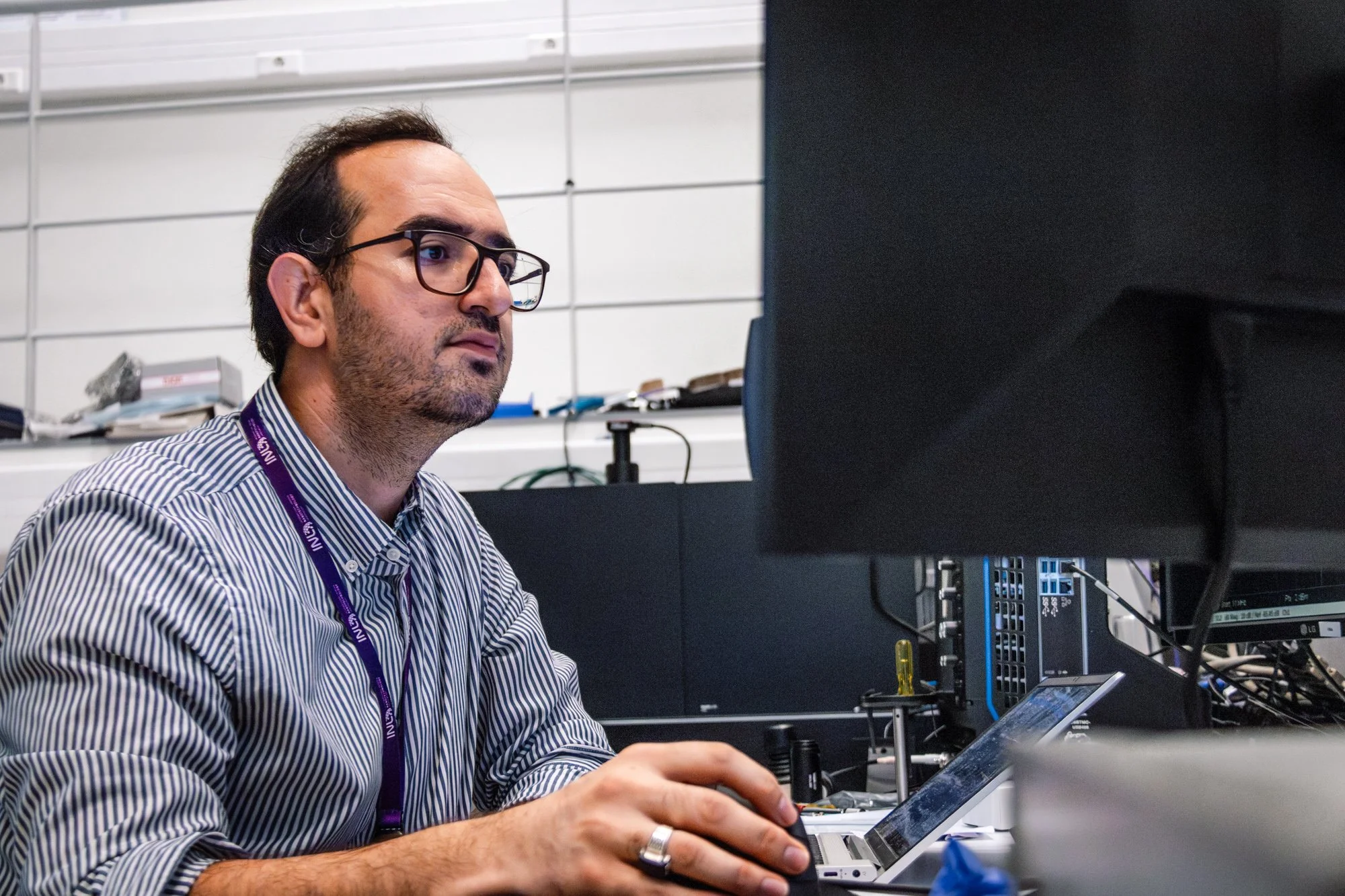
Omid Ranjbar, first author of the study
The results also show that biased dimensional deviations of around ±10 nm tend to have a relatively small effect on device performance. Larger deviations, however, generally need closer attention, as they have a more pronounced influence on the devices’ photonic, phononic and optomechanical characteristics.
Ultimately, by helping engineers identify the design features most susceptible to manufacturing variations, the study contributes to the development of more robust nanodevices and better designs for future photonic and optomechanical technologies.
This work was supported by the CHIST-ERA project MUSICIAN (through the Spanish Ministry of Science and Innovation, Grant No. PCI2022-135003-2, and the Academy of Finland, Grant No. 357745), the Horizon Europe Marie Skłodowska-Curie Actions Postdoctoral Fellowship PIONEER (Grant Agreement No. 101211881), the Horizon Europe project MAGNIFIC (Grant Agreement No. 101091968), and the ERC Advanced Grant LEIT (Grant Agreement No. 885689).